
The Hidden 10 Framework
The Problem
Businesses led by African women often have limited access to formal finance, strategic networks, and operational resources, restricting their capacity to scale despite market demand (African Development Bank, 2023; Techpoint Africa, 2025).Women-led ventures in Africa receive a disproportionately small share of startup financing. In 2024, female-led startups captured only 2–3% of total venture funding, despite representing a significant portion of the continent’s entrepreneurial activity (Disrupt Africa, 2023; Gates Foundation, 2025; Sunny, 2025). Access to formal credit remains similarly constrained: only 37% of African adult women have bank accounts, compared with 48% of men, limiting participation in formal financial systems and the ability to secure growth capital (Morsy, 2020).Beyond finance, structural and cultural factors further limit growth. Informal community-based systems such as rotating savings or microcredit initiatives provide critical support, but cannot fully compensate for systemic inequities (African Development Bank Group, 2021). Social and cultural expectations regarding leadership and economic responsibility place additional burdens on women founders, often requiring them to navigate both operational management and community obligations simultaneously.The cumulative effect is that while African women drive significant entrepreneurial activity, many businesses stall at the stage where revenue exists but systemic support is insufficient to move toward scale. Limited access to capital, resources, and networks continues to constrain long-term growth, leaving structural gaps that prevent African women-led businesses from achieving broader economic influence and sector leadership.The African Women-Led Business Pipeline
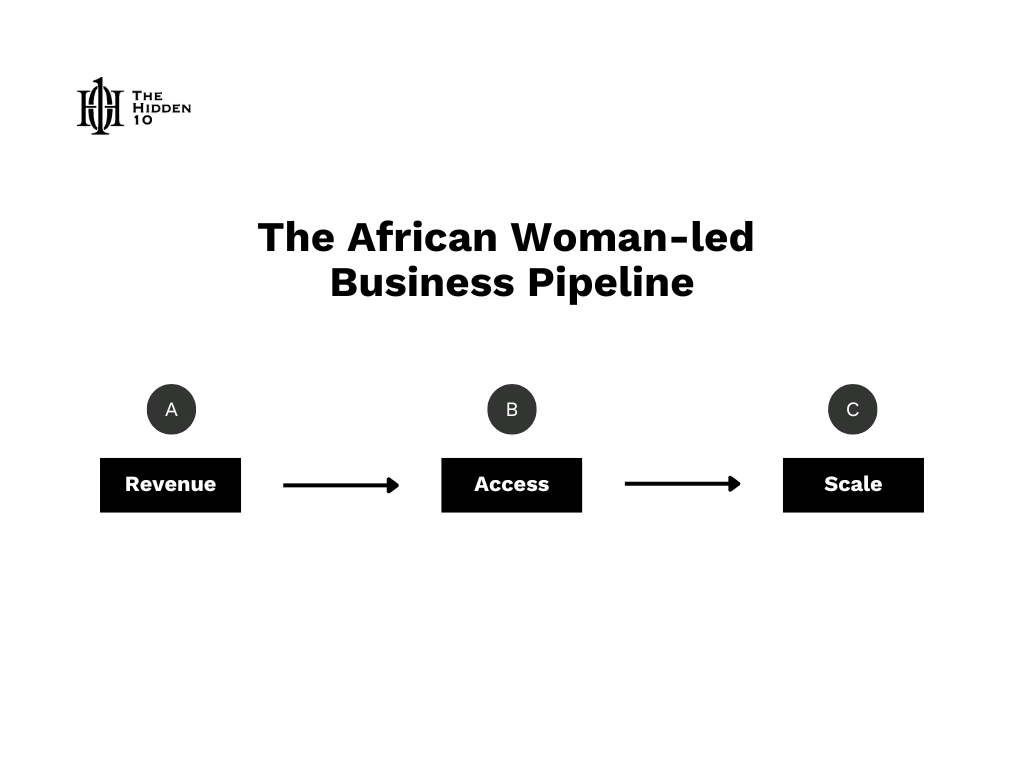
This diagram illustrates the typical growth trajectory of African women-led businesses. Businesses generate Revenue, demonstrating market validation, but often stall at the Access stage due to structural barriers such as limited capital, resources, and strategic networks. Scale is achieved only when these barriers are addressed, enabling sustainable growth and sector influence.
The structural challenges faced by African women entrepreneurs directly shape their progression along the business growth trajectory. This progression can be conceptualized as a Revenue → Access → Scale pipeline, which highlights the stages at which businesses typically encounter barriers to growth.Revenue: Businesses at this stage are generating revenue, demonstrating validated products or services, and exhibiting market traction. This stage reflects proof of concept and operational viability.Access: The critical stage at which businesses require external capital, operational resources, and strategic networks to expand beyond their initial market presence. Structural barriers identified in the problem - such as limited access to formal finance, constrained institutional support, and underdeveloped networks - manifest most acutely at this stage. Empirical data indicates that a substantial proportion of African women-led businesses remain in this phase, generating revenue but unable to secure the resources necessary to move toward scale (Disrupt Africa, 2023; Techpoint Africa, 2025).Scale: The stage at which businesses effectively leverage systemic support to achieve sustainable growth, broader market influence, and sector leadership. Without targeted interventions at the Access stage, businesses often fail to progress to this stage despite demonstrated market demand.
The link between the structural barriers and the pipeline is direct: limited access to capital, resources, and networks prevents African women-led businesses from transitioning smoothly from Revenue to Scale. This pipeline highlights the “sticky middle” where revenue exists, but systemic access remains limited, thereby impeding growth and market influence (African Development Bank, 2023; WE4A, 2024).The Hidden 10 Framework
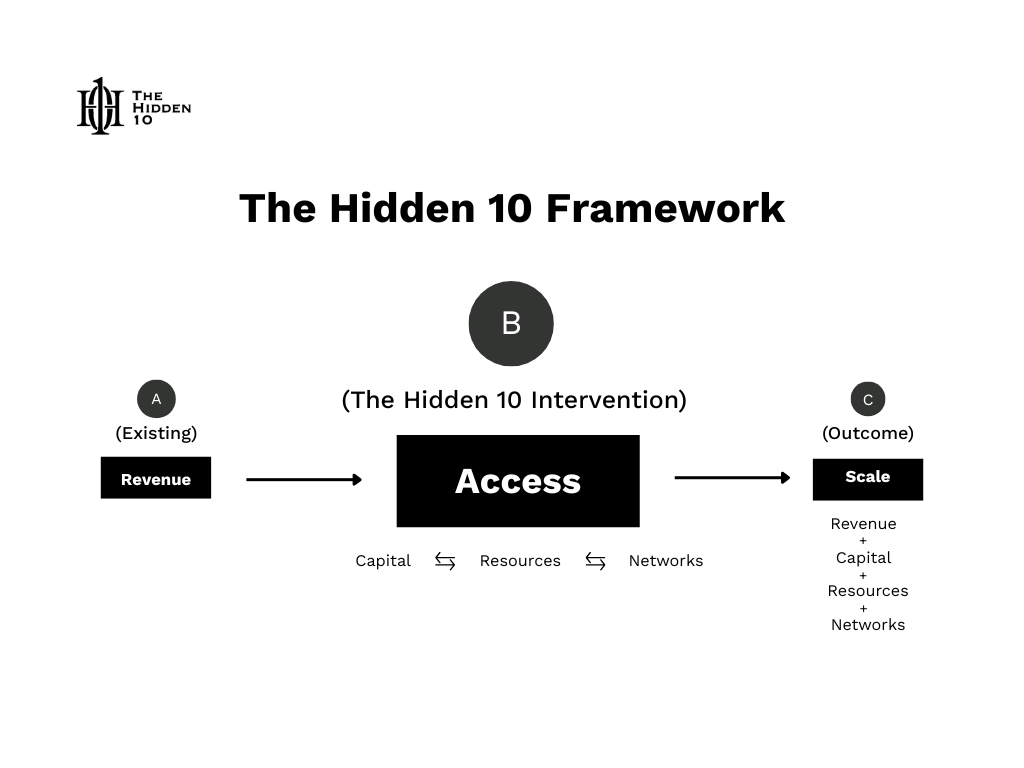
This diagram depicts how the Hidden 10 Framework operationalizes the Access stage through three interdependent levers: Capital, Resources, and Networks. When effectively combined with existing Revenue, these levers enable businesses to achieve Scale.
The Hidden 10 Framework constitutes the foundation upon which targeted interventions are designed to address the structural gaps identified in the pipeline. It operationalizes the Access stage by providing a structured and interdependent approach through three strategic levers:Capital: Access to funding that removes immediate operational friction, allowing founders to invest strategically, overcome bottlenecks, and accelerate growth.Resources: Curated knowledge, research, operational tools, and expert insights that strengthen decision-making, execution, and leadership capacity.Networks: Connections to peers, advisors, investors, and strategic partners that expand opportunity, visibility, and influence.
These levers are interdependent. Capital without resources or networks limits strategic implementation; resources without capital or networks reduce impact; networks without actionable resources and capital leave potential untapped. The combined application of these levers creates a structured pathway from Access to Scale, enabling African women-led businesses to convert proven revenue into sustainable growth, competitive positioning, and long-term market influence.Next Steps
Founders seeking to advance from revenue to scale can begin by applying to The Key Network. This environment provides Black women founders across Africa and the diaspora with structured guidance, research, and frameworks that enable strategic decision-making and long-term growth. Accepted applicants become Keyholders. Applications are evaluated on a rolling basis. Keyholders also have the opportunity to participate in The Key Network Exchange and The Key Network Roundtable.
The Key Network Exchange facilitates introductions to peers, advisors, investors, and strategic partners. The Exchange provides curated connections that help unlock business opportunities and accelerate growth.
The Key Network Roundtable provides a structured, facilitated environment where founders bring real business challenges and work through them in real time with peers and a moderator. Each session is focused on practical problem-solving, enabling founders to leave with clarity, actionable insights, and next steps.The Founder Fund is available exclusively to Keyholders engaged in The Exchange and The Roundtable. It provides targeted financial support to address operational constraints and invest in initiatives that drive sustainable expansion.References
African Development Bank. (2023). Africa Gender Index Report 2023. https://www.afdb.org/sites/default/files/documents/publications/241108-africa_gender_index_report_2023_v11.pdf

Disrupt Africa. (2023). New report lays bare lack of gender diversity in African tech startup ecosystem. https://disruptafrica.com/2023/06/05/new-report-lays-bare-lack-of-gender-diversity-in-african-tech-startup-ecosystem/

Techpoint Africa. (2025). Why African venture capital must target local female entrepreneurs. https://techpoint.africa/insight/african-venture-capital-must-target-female-entrepreneurs/

WE4A (Women Entrepreneurship for Africa Accelerator). (2024). Women entrepreneurship for Africa acceleration programme: Key gender gaps in the African entrepreneurial ecosystem. https://www.tonyelumelufoundation.org/wp-content/uploads/dlm_uploads/2024/08/Safeem_WomenEntrepreneurshipforAfricaAccelerationprogramme_V4.pdf

Gates Foundation. (2025). Expanding women’s access to capital to increase women’s economic power. https://www.gatesfoundation.org/ideas/womens-economic-power/access-capital

Morsy, H. (2020). Africa’s gender gap in access to finance for women entrepreneurs. International Monetary Fund. https://www.imf.org/en/publications/fandd/issues/2020/03/africa-gender-gap-access-to-finance-morsy?

Sunny, D. (2025). Female-led ventures get just 2% as Africa’s startup funding dips in March 2025. https://techpoint.africa/news/africas-funding-dips-march/

The Hidden 10. (2025). Structural forces driving African women toward entrepreneurship: Economic, cultural, and leadership implications. https://www.thehidden10.com/article/career/the-structural-forces-driving-black-women-toward-entrepreneurship-economic-cultural-and-leadership-implications
Further Reading: The Hidden 10. (2025). Structural forces driving African women toward entrepreneurship: Economic, cultural, and leadership implications. https://www.thehidden10.com/article/career/the-structural-forces-driving-black-women-toward-entrepreneurship-economic-cultural-and-leadership-implications
Further Reading: Insight Articles (The Hidden 10)
Black woman, business, leadership, 2026, funding, capital, Black women network, Black women business, business owner, network, scale

